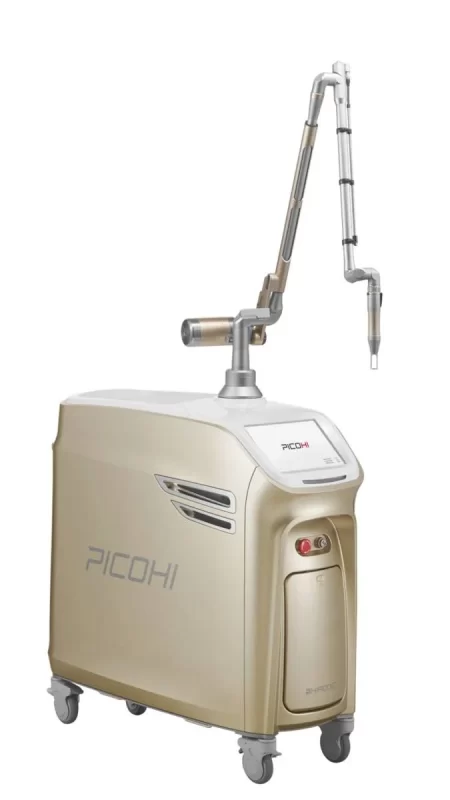
Darkening of the skin after picosecond laser or other pigmentation treatments does not automatically mean the treatment failed, nor can it be uniformly called “normal melanin excretion.” It is necessary to distinguish between recovery-phase changes, post-inflammatory hyperpigmentation, and original pigment issues by considering the timing of onset, color distribution, whether the surface is crusted, and the presence of redness, swelling, or pain.
What kind of condition might the “post-treatment darkening” people talk about be?
| Observed changes | Conditions to distinguish between |
|---|---|
| Dry, dark-colored scabs on the skin surface | This may be part of the surface healing process after this treatment, but do not pick at the scabs yourself to check. |
| Flat brown or grayish-brown marks appearing in the treated area after the skin has fully healed | Post-inflammatory hyperpigmentation should be evaluated, and comparison with the original spots is also necessary. |
| The original area gradually darkens again, or pigment changes appear in other areas | The persistence or recurrence of the original condition, or new triggering factors, should be considered. |
| Color changes accompanied by significant pain, blisters, oozing, or worsening redness and swelling | Prompt evaluation for injury, infection, or other issues is needed; do not simply wait assuming it is just hyperpigmentation. |
It is difficult to make the above judgments based solely on color depth. Photos can help with comparison, but in-person consultations and original treatment records are often more valuable, especially when different issues overlap.
What is post-inflammatory hyperpigmentation, and why does it occur after pigmentation treatments?
Post-inflammatory hyperpigmentation, often abbreviated as PIH, is a darkening of the skin that occurs after the skin experiences inflammation or injury. The goal of pigmentation treatments is to improve specific pigment issues, but hyperpigmentation can still occur after the skin is irritated — these two are not contradictory.
A history of easily leaving acne marks, post-treatment inflammatory reactions, sun exposure, and repeated irritation during recovery can all affect the outcome. Even with picosecond technology, this risk cannot be reduced to zero; once hyperpigmentation appears, the skin condition and follow-up plan need to be re-evaluated.
When you notice darkening, what should you do first?
Record the treatment date, when the darkening started, and whether the affected area is expanding, stable, or fading.
Keep pre-treatment photos and compare them with current photos under similar lighting, without using filters.
List all skincare products, medications, and other procedures used during the recovery period.
Contact your treating doctor and inform them if you have accompanying stinging, itching, redness, swelling, blisters, or oozing.
Do not temporarily add acid products, exfoliants, strong whitening products, or another laser treatment just to make the darkening fade faster. Irritation can make judgment more difficult and may also increase the burden on the skin. Whether to adjust prescribed medications you are already using should be discussed with the prescribing doctor.
How to apply sunscreen after post-treatment darkening, and what to do if the skin is broken?
When the skin can tolerate it, use a broad-spectrum sunscreen with SPF 30 or higher as recommended by your doctor, along with sun protection clothing and reduced direct sun exposure. The actual amount of sunscreen applied, reapplication frequency, and daily sun exposure are equally important — do not only rely on the numbers on the bottle.
If there is still broken skin, oozing, or obvious stinging, first follow medical advice for wound care and use appropriate sun protection. Confirm separately when sunscreen can be applied to that area. People with conditions such as melasma can also ask whether protection against visible light is needed.
How long does it take for the darkening to fade, and can I get another treatment right away?
Hyperpigmentation usually takes months to fade, and some cases take longer; the specific progress depends on the location of the pigment, whether the trigger persists, and the skin condition. You cannot use someone else’s recovery time to replace your own follow-up assessment.
Your doctor may discuss observation, topical treatments, or other management based on your specific situation. Whether to use energy-based devices again requires re-evaluation. Increasing the energy level or shortening the treatment interval as soon as unexplained pigment changes appear is not a universal solution.
Frequently Asked Questions
If the scabs are very dark, does that mean the post-treatment darkening will definitely be severe?
You cannot draw a direct conclusion. The scab and the pigment changes within the skin need to be observed separately; do not pick at the scab yourself.
Will post-treatment darkening leave a permanent mark?
Not necessarily. Many cases of hyperpigmentation can fade gradually, but the timeline varies greatly. The cause and trend should be assessed through follow-up consultations.
Is the aftercare for spot recurrence exactly the same as for post-inflammatory hyperpigmentation?
Not necessarily. The two conditions can coexist, and the main cause needs to be identified first before proceeding with further treatment.
When should you stop waiting for a photo-based consultation response?
If you experience significantly worsening pain, blistering, oozing, or other acute abnormalities, seek in-person medical evaluation promptly.
If you notice color changes after receiving pigment treatment at B:AID, you can provide the treatment date, clear photos, and accompanying symptoms to help the attending doctor determine whether an earlier follow-up is needed.